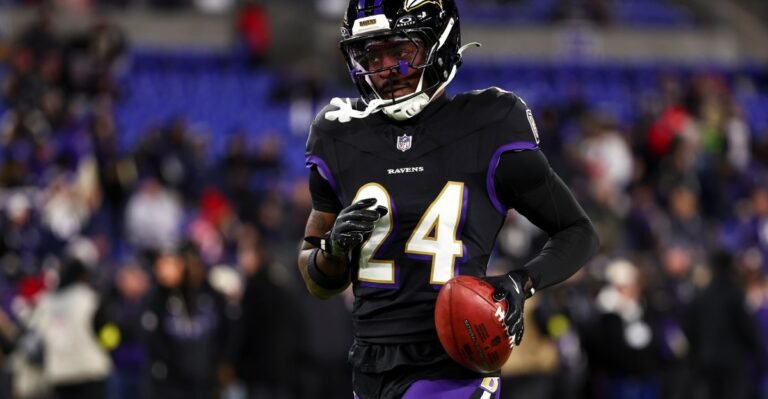
The Ravens’ early season is now over, and all attention has shifted to the ongoing search for the next head coach. It is also a good time to look back at the 2025 season, and the performance of certain players. This includes the rookie class. We’ll grade each Baltimore rookie drafted this year and review their performance.
S Malaki Starks
The Ravens’ first round pick was expected to step into the starting safety position in the defensive backfield from day one. Starks, who had an impressive college career at Georgia, was touted as an NFL-ready freshman. Starks had his ups anddowns like many first-year starters. This was especially true early in the season. Starks was not always consistent in his open-field tackles and was also responsible for some coverage mistakes. Starks’s strength increased as the season progressed. As a deep safety, he displayed natural coverage instincts. He covered ground well and filled the right spots. Starks did not make many big plays during the season, in part because he was rarely around the ball. In the middle of the season, he did manage to grab two interceptions back-to-back. He also finished the year with 84 total tackles, the fourth-most in the team, and four pass breaks in more than 1,065 defensive snaps (94%). Starks has a lot of room to improve, but he also inspired confidence in his ability to be a strong starter for the Ravens going forward.
Mike Green, EDGE
Green, a Ravens second-round selection, was considered a great value and a potential steal on draft day. Green was one the most productive pass rushers in college the previous year. It was hoped that his natural ability would translate immediately. Green was expected to be a pass rusher on passing downs, mainly in the Ravens edge rusher group, which was fairly deep before the season started. Green played more defensive snaps than expected, totaling 712 (63%) due to the injuries that plagued this position group and subpar performances from returning veterans. Results were mixed. Green became more influential as the season progressed. He ended up with 3.5 sacks and 19 pressures. He was inconsistent at times and would have been better off playing fewer snaps, with less responsibility on every down. Green has shown flashes that he could be a high-level pass rusher, but he also needs to improve his technique and run defense.
OG Emery Jones Jr.
Jones missed the entire first half of the year as he recovered after shoulder surgery in the offseason. When he finally became healthy and able to play, LSU’s Jones had a hard time breaking into the rotation of the offensive line. Andrew Vorhees, Daniel Faalele, and the Ravens’ offensive line were set in their ways as the team’s starters. Despite their struggles, the Ravens refused to alter the starting lineup. Jones was briefly rotated in to replace Vorhees as left guard for a few drives, but this only lasted about a single game. Jones displayed a promising athletic ability and legitimate upside when he was playing. Jones is still a bit raw when it comes to technique and consistency but that’s expected since he was a rookie who missed a long period of time. Jones played 49 offensive snaps in total and appeared in five games. Jones didn’t get a fair grade, but he will be in the running for a starter role next season.
ILB Teddye Buchanan
Buchanan surprised many by securing a linebacker starting spot early in the season. He replaced Trenton Simpson, who was the running partner of Roquan Smith. Buchanan, a fourth-round selection, showed an impressive level of confidence in defense, and his technique was sound. His role increased quickly. Buchanan had a mixed year, with ups and downs in his performance. He has room to improve, especially on coverage consistency and open field tackling. He was solid against the running game and ended up with 93 total tacklings and one forced fumble. He was named AFC Defensive Player of the Month in October. Buchanan’s rookie season was unfortunately cut short by a torn anterior cruciate ligament in mid-December. Overall, he exceeded expectations and showed starter-level abilities at his position.
OT Carson Vinson
Vinson only played in seven games, and he took seven offensive snaps. It is difficult to assess his rookie year. Vinson was selected as a fourth-round developmental prospect, and wasn’t expected in Year 1 to do much more than play a backup. The Ravens are confident that his athletic profile and other traits will help him develop into a starting-level player in the future.
K Tyler Loop
Loop’s rookie season ended in the worst way possible. He missed a 44 yard field goal that, had it been successful, would have sent Ravens into the playoffs. This untimely missed overshadows what would have been a great season for the new kicker. Loop scored 134 points and made 30 of 34 attempts (88.2%). Loop had been perfect in all his kicks under 50 yards before the miss in the final game. The accuracy of the sixth-rounder’s kicks from distance was not up to par, however, as on his four attempts, he only made one kick over 50 yards. Loop was efficient in general, but he was not reliable from long distances and was ultimately not reliable when it counted the most.
WR LaJontay Wester
Wester failed to break into the wide receiver rotation or carve out a role on offense in his rookie year. In the back of the depth chart, he played only 58 offensive snaps (6%). Wester was the primary kick and punt returner for the team from the beginning of the season, as he had been expected to be. He returned 10 kickoffs and 16 punts, totaling 246 yards. Wester only fumbled the ball twice, but was otherwise pretty confident with it.
DT Aeneas Peebles
Sixth-rounder from Virginia Tech, Peebles was considered a sleeper who could have a big impact on the Ravens’ first season. Peebles, however, didn’t get much of a shot. Early in the season, Peebles was an important part of the defensive line rotation. He played 67 snaps over the first five week. Peebles was then dropped by the coaching staff. He remained a healthy scratch for the remainder of the season, and only played four snaps in Week 13 against the Cincinnati Bengals. Peebles had the pass-rushing skills to allow him to play a lot more. However, the Ravens did not trust his ability to defend against the running game. Peebles will have the chance to play a bigger role next year, as Ravens defensive line is likely to feature several newcomers.